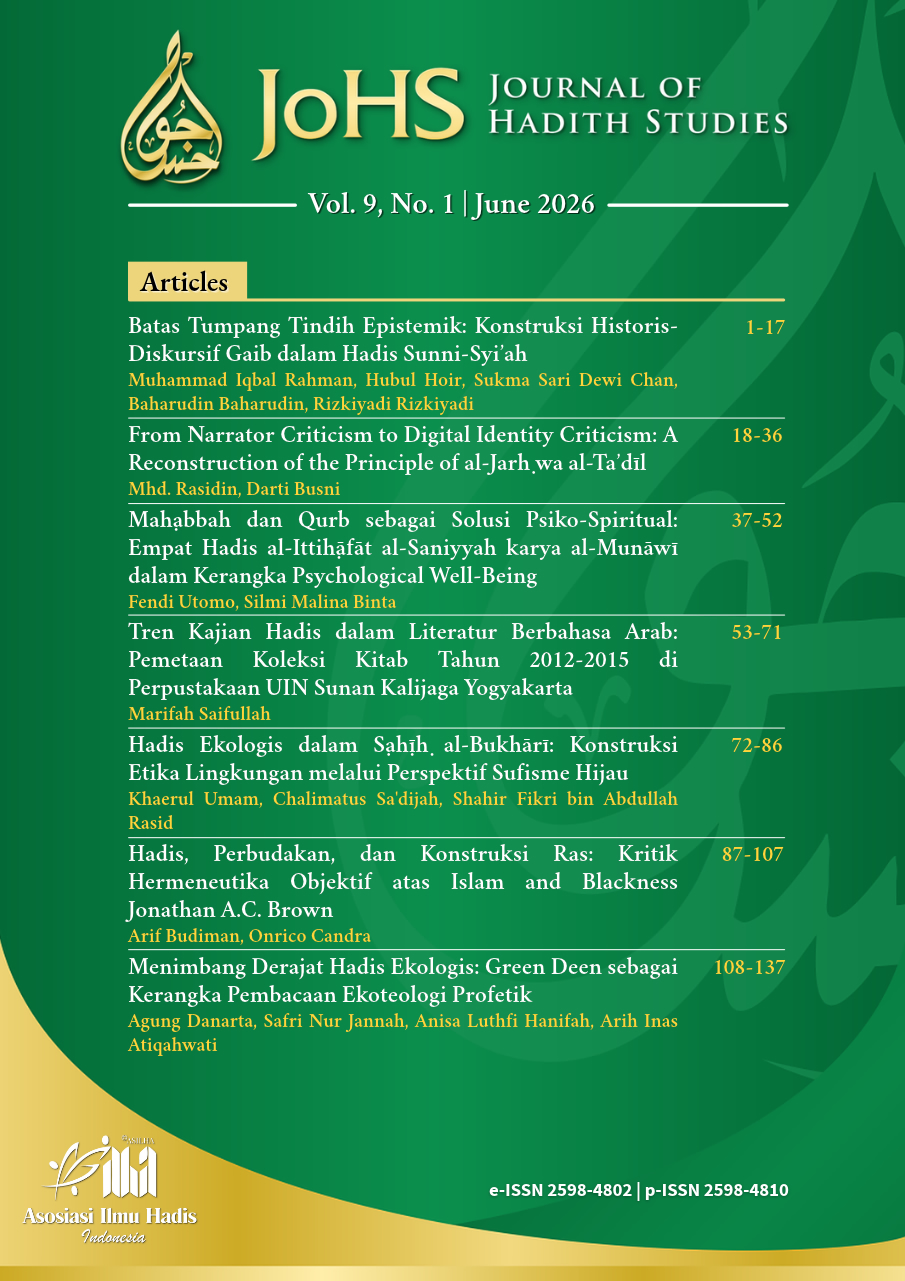
Hadis, Perbudakan, dan Konstruksi Ras: Kritik Hermeneutika Objektif atas Islam and Blackness Jonathan A.C. Brown
DOI:
https://doi.org/10.32506/johs.v9i1-02Keywords:
ḥadīth, cultural relativism, racism, slavery, objective hermeneutics, Jonathan A.C. BrownAbstract
The accusation that Islam is anti-Black has become one of the most controversial issues in contemporary Islamic discourse, particularly following the emergence of the Black Lives Matter movement and the growing academic attention to the history of slavery in Islamic civilization. This article critically analyzes how cultural relativism operates in the interpretation of ḥadīths related to slavery and race, with a primary focus on Jonathan A.C. Brown’s Islam and Blackness (2022). The study employs library research with a critical-hermeneutic approach, applying Emilio Betti’s four canons of objective hermeneutics to evaluate the methodological consistency of Brown’s reading of the ḥadīth corpus, classical matn criticism, and historiographical data on slavery in Muslim societies. The findings yield two interrelated levels of analysis. First, cultural relativism operates through five social-epistemic dimensions in Islamic ḥadīth criticism: ḥadīth canonization, social prejudice, matn criticism methodology, the thought of individual scholars, and Sufi symbolism. Second, evaluation through Betti’s four canons shows that Brown’s approach is generally consistent in terms of the autonomy of the object, coherence of meaning, and historical correspondence, yet remains less explicit in disciplining his own pre-understanding as a Muslim academic in North America. These dimensions reveal that the Islamic ḥadīth scholarly tradition possesses internal critical mechanisms, rooted in the principle of naqd al-matn since Ibn Qayyim al-Jawziyyah (d. 751 AH), which have repeatedly been employed to reject racial narratives, although their application has varied according to historical contexts. This article contributes to contemporary ḥadīth studies by offering an analytical framework of five dimensions of cultural relativism for rereading ethically problematic religious texts, thereby avoiding both moral anachronism and uncritical apologetics.
References
Africanus, L. (1896). The History and Description of Africa and of the Notable Things Therein Contained (R. Brown, Ed.; 1st ed., Vol. 1). Cambridge University Press.
al-’Asqalānī, A. bin ’Alī bin Ḥajar. (1390). Fatḥ al-Bārī Syarḥ al-Bukhārī (M. F. ’Abd al-Bāqī, Ed.; 1st ed., Vol. 13). Al-Maktabah as-Salafiyyah.
al-Baihaqī, A. B. A. bin al-Ḥusain. (1970). Manāqib asy-Syāfi’ī lil-Baihaqī (A.-S. A. Ṣaqr, Ed.; 1st ed., Vol. 2). Maktabah Dār at-Turāts.
al-Ghazālī, M. (1989). Al-Sunnah al-Nabawiyyah bayna Ahl al-Fiqh wa Ahl al-Ḥadīth (1st ed.). Dār al-Shurūq.
al-Idlibī, Ṣalāḥ al-Dīn ibn Aḥmad. (2013). Manhaj Naqd al-Matn ʿinda ʿUlamāʾ al-Ḥadīth al-Nabawī (2nd ed.). Dār al-Fatḥ li-l-Dirāsāt wa al-Nashr.
al-Jauzī, J. ad-D. A. al-F. ’Abd ar-R. bin ’Alī bin M. (1998). Tanwīr al-Ghabasy fī Faḍl as-Sūdān wal-Ḥabasy (M. ’Alī Ibrāhīm, Ed.; 1st ed.). Dār asy-Syarīf.
al-Jawzī, J. ad-D. ’Abd ar-R. bin ’Alī bin M. (1966). Al-Mauḍū’āt (’Abd ar-Raḥmān Muḥammad ’Uthmān, Ed.; 1st ed., Vol. 2). al-Maktabah as-Salafiyyah.
al-Jawziyyah, A. ’Abdillāh M. bin A. B. bin A. I. Q. (2019). Al-Manār al-Munīf fī aṣ-Ṣaḥīḥ waḍ-Ḍa’īf (Y. bin ’Abd A. Ats-Tsamālī, A. bin A. bin Ṭāhir al-Indūnīsī, & Y. bin ’Abd A. Asy-Syuhrī, Eds.; 4th ed.). Dār Ibn Ḥazm.
al-Jurjānī, A. A. bin ’Adī (with Abū Sunnah, ’Abd al-Fattāḥ). (1997). Al-Kāmil fī Ḍu’afā’ ar-Rijāl (’Ādil Aḥmad ’Abd al-Maujūd & ’Alī Muḥammad Mu’awwaḍ, Eds.; 1st ed., Vol. 6). al-Kutub al-’Ilmiyyah.
al-Mizzī, J. ad-D. A. al-Ḥajjāj Y. (1992). Tahżīb al-Kamāl fī Asmā’ ar-Rijāl (Dr. B. ’Awwād Ma’rūf, Ed.; 1st ed., Vol. 20). Mu’assasah ar-Risālah.
al-Naisābūrī, A. al-Ḥusain M. bin al-Ḥajjāj al-Qusyairī. (1955). Ṣaḥīḥ Muslim (M. F. ’Abdil Bāqī, Ed.; Vol. 3). Maṭba’ah ’Īsā al-Bābī al-Ḥalabī wa Syurakāh.
al-Qaraḍāwī, Y. (2002). Kayfa Nataʿāmal maʿa al-Sunnah al-Nabawiyyah: Maʿālim wa Ḍawābiṭ (2nd ed.). Dār al-Shurūq.
al-Qurṭubī, A. ‘Abdillāh M. bin A. al-Anṣārī. (1964). Al-Jāmi’ li-Aḥkām al-Qur’ān (A. Al-Bardūnī & I. Aṭfīsy, Eds.; 2nd ed., Vol. 16). Dār al-Kutub al-Miṣriyyah.
Al-Alwani, T. J. (2003). Source Methodology In Islamic Jurisprudence (3rd ed.). The International Institute of Islamic Thought.
Al-Attas, S. M. al-Naquib. (1981). Islam dan Sekularisme (A. Mahzar, Ed.; K. Djojosuwarno, Trans.). Penerbit Pustaka.
Al-Azharī, L. al-Ḥākim al-I. (2017). Imdād al-Mugīṡ bi Tashīl ‘Ulūm al-Ḥadīṡ. Dār as-Ṣālīḥ.
Al-Fidā’, I. bin M. bin ’Abd al-H. al-J. al-’Ajlūnī ad-D. A. (2000). Kasyf al-Khafā’ wa Muzīl al-Ilbās (’Abd al-Ḥamīd bin Aḥmad bin Yūsuf bin Hindāwī, Ed.; 1st ed., Vol. 1). Al-Maktabah al-’Aṣriyyah.
Al-Ghumārī, A. bin al-Ṣiddīq. (1982). Al-Mughīr ʿalā al-aḥādīth al-mawḍūʿa fī al- Jāmiʿ al-ṣaghīr. Dār al-Rā’id al-ʿArabī.
Al-Idlibi, Ṣalahuddīn. (2004). Manhaj Naqd al-Matn ‘Ind ‘Ulama al-Ḥadīṡs al-Nabawī. Gaya Media Pratama.
Al-Jahiz, A. U. (1981). Kitab Fakhr al-Sudan ’ala al-Baydan (G. Albrecht, Ed.). Franz Steiner Verlag.
Al-Ju’fi, A. A., Muhammad bin Isma’il bin Ibrahim bin Al-Mughirah bin Bardizbah Al-Bukhari. (1422). Ṣaḥīḥ al-Bukhārī (Dr. M. Z. al-Nāṣir, Ed.; 1st ed., Vol. 9). Dar Ṭawq al-Najah.
Al-Khaṭīb, M. ‘Ajjāj. (2019). Uṣūlul-Ḥadīṡ, Ulūmuhu wa Muṣṭalaḥuhu. Dar al-Fikr.
al-Marzūqī, A. Y. (2010). Iṣlāḥ al-ʿAql fī al-Falsafa al-ʿArabiyya (3rd ed.). Dār al-Ṭalīʿa.
An-Nawawī, A. Z. M. ad-D. Y. bin S. (1392). Al-Minhāj Syarḥ Ṣaḥīḥ Muslim bin al-Ḥajjāj (2nd ed., Vol. 9). Dār Iḥyā’ at-Turāts al-’Arabī.
Ar-Rāzī, A. M., ’Abd ar-Raḥmān bin Abī Ḥātim. (2003). Ādāb asy-Syāfi’ī wa Manāqibuh (1st ed.). Dār al-Kutub al-’Ilmiyyah.
As-Sakhāwī, S. ad-D. M. bin ’Abd ar-Raḥmān. (2017). Al-Maqāṣid al-Ḥasanah fī Bayān Katsīr min al-Aḥādīts al-Masyhūrah ’alā al-Alsinah (’Abd al-Mu’ṭī bin ’Abd ar-Razzāq al-Bukūr, Ed.; 1st ed., Vol. 1). Maktabah al-Maimūnah al-Madaniyyah.
Aṣ-Ṣāliḥ, Ṣubḥī. (1988). ‘Ulūmul-Ḥadīṡ wa Muṣṭalaḥuhu. Dārul-Ilm lil_Malāyīn.
As-Suyūṭī. (1995). Azhār al-ʿurūsh fī akhbār al-ḥubūsh (A. M. Al- & Ghazālī, Eds.). Markaz al-Makhṭūṭāt wa’l-Turāth wa’l-Wathā’iq.
Asy-Syaukānī, M. bin ’Alī bin M. (n.d.). Al-Fawā’id al-Majmū’ah fī al-Aḥādīts al-Mauḍū’ah (’Abd ar-Raḥmān bin Yaḥyā al-Mu’allimī al-Yamānī, Ed.). Dār al-Kutub al-’Ilmiyyah.
Aż-Żahabī, S. ad-D. M. bin A. bin ’Utsmān. (2006). Siyar A’lām an-Nubalā’ (Vol. 10). Dār al-Ḥadīts.
Bashir, H. (2019). Black Excellence and the Curse of Ham: Debating Race and Slavery in the Islamic Tradition. ReOrient, 5(1). https://doi.org/10.13169/reorient.5.1.0092
Betti, E. (2021). Hermeneutics as a General Methodology of the Sciences of the Spirit (1st ed.). Routledge.
Bourdieu, P. (1990). The Logic of Practice (R. Nice, Ed.). Stanford University Press.
Brown, J. A. C. (2020). Slavery and Sufism: The Ḥilyat al-Awliyā’ of Abū Nuʿaym al-Iṣbahānī (d. 430/1038) as a Source on Slavery in Medieval Islamic Civilization. Annals of Japan Association for Middle East Studies (AJAMES), 36(2). https://doi.org/10.24498/ajames.36.2_29
Brown, J. A. C. (2022a). Islam & Blackness. Oneworld Academic (imprint of Oneworld Publications).
Brown, J. A. C. (2022b). Islam and Blackness. Oneworld Academic.
Budiman, A., Safri, E., & Wendry, N. (2020). Studi Kritik Hadis Perspektif Jonathan A.C. Brown (Analisis terhadap Three Tiered Method). Substantia: Jurnal Ilmu-Ilmu Ushuluddin, 22(1), 1. https://doi.org/10.22373/substantia.v22i1.6853
Busacchi, V. (2021). Emilio Betti: On Interpretation Objectivity. Critical Hermeneutics, 5(1). https://doi.org/10.13125/CH/4955
Cronin, S. (2021). Islam, Slave Agency and Abolitionism in Iran, the Middle East and North Africa. In Social Histories of Iran: Modernism and Marginality in the Middle East (1st ed.). Cambridge University Press.
El Hamel, C. (2013). Black Morocco: A History of Slavery, Race, and Islam. Cambridge University Press.
Goldenberg, D. M. (2003). The Curse of Ham: Race and Slavery In Early Judaism, Christianity, and Islam. Princeton University Press.
Habib, & Habib, Moh. (2022). Semiotic-Sufistic Interpretation of Imam Al-Ghazali: A Case Study of The Verses of Light in the Holy Qur’an. Indonesian Journal of Islamic Literature and Muslim Society, 7(2). https://doi.org/10.22515/islimus.v7i2.7529
Ḥanafī, Ḥasan. (1980). Al-Turāth wa al-Tajdīd: Mawqifunā min al-Turāth al-Qadīm (1st ed.). Al-Markaz al-ʿArabī lil-Baḥth wa al-Nashr.
Ḥanbal, al-I. A. bin. (2001). Musnad al-Imām Aḥmad bin Ḥanbal (S. al-Arnaūṭ & ‘Ādil Mursyid, Eds.; 1st ed., Vol. 38). Mu’assasah al-Risālah.
Haour, A. (2011). The Early Medieval Slave Trade of the Central Sahel: Archaeological and Historical Considerations. In P. J. Lane & K. C. Macdonald (Eds.), Slavery In Africa: Archaeology and Memory. The British Academy by Oxford University Press.
Hasanah, U. (2023). Historical Approach in Understanding Hadith. UMRAN - International Journal of Islamic and Civilizational Studies, 10(2), 37–51. https://doi.org/10.11113/umran2023.10n2.598
Ibn ’Asākir, A. al-Q. ’Alī bin al-Ḥasan bin H. A. bin ’Abd A. asy-Syāfi’ī al-Ma’rūf bi. (1995). Tārīkh Madīnah Dimasyq, wa Żikr Faḍlihā wa Tasmiyah man Ḥallahā min al-Amātsil aw Ijtāza bi Nawāḥīhā min Wāridīhā wa Ahlihā (M. ad-D. A. S. ’Umar bin G. al-’Amrawī, Ed.; Vol. 40). Dār al-Fikr.
Kholis, N. (2021). Kritik Atas Kritik Matan Jonathan A.C Brown. Tajdid, 20(1).
Kholishuddin, K., & Ilmi, Moh. H. H. (2023). Implementation of Manhaj Maqāṣidī Bin Bayah in Understanding Hadith (Fiqh Ḥadīṡ). Nabawi: Journal of Hadith Studies, 4(1), 45–81. https://doi.org/10.55987/njhs.v4i1.63
Klein, M. A. (1998). Slavery and Colonial Rule in French West Africa (1st ed.). Cambridge University Press.
Lewis, B. (1990). Race and Slavery in the Middle East: An Historical Enquiry. Oxford University Press.
Lovejoy, P. E., & Hogendorn, J. S. (1993). Slow Death for Slavery: The Course of Abolition in Northern Nigeria, 1897-1936. Cambridge University Press.
Pulungan, N. Hamidah. (2023). An Orientalist Today: Jonathan A.C. Brown’s Thoughts on Hadith. Ulumuna: Journal of Islamic Studies, 27(2), 552–572.
Rosenthal, F. (1989). The History of al-Ṭabarī: General Introduction and From the Creation to the Flood (Vol. 1). State University of New York Press.
Schine, R. N. (2019). On Blackness in Arabic Popular Literature: The Black Heroes of the Siyar Sha’biyya, Their Conceptions, Contests, and Contexts [Dissertation]. The University of Chicago.
Sufi, M. K., & Yasmin, M. (2022). Racialization of public discourse: Portrayal of Islam and Muslims. Heliyon, 8(12). https://doi.org/10.1016/j.heliyon.2022.e12211
Ula, M. (2016). Simbolisme Bahasa Sufi (Kajian Hermeneutika Terhadap Puisi Hamzah Fansuri). Religia: Jurnal Ilmu-Ilmu Keislaman, 19(2). https://doi.org/10.28918/religia.v19i2.748
Wasman, Mesraini, & Suwendi. (2023). A CRITICAL APPROACH TO PROPHETIC TRADITIONS: Contextual Criticism in Understanding Hadith. Al-Jami’ah, 61(1), 1–17. https://doi.org/10.14421/ajis.2023.611.1-17
Zaman, M. (2024). A Tale of Two Ḥanafīs: The Intellectual Legacies of Anwar Shāh Kashmīrī and Muḥammad Zāhid al-Kawtharī. Journal of Hanafi Studies, 2(1), 31–73.
ʿItr, N. al-Dīn. (1981). Manhaj al-Naqd fī ʿUlūm al-Ḥadīth (3rd ed.). Dār al-Fikr.
Downloads
Published
Issue
Section
License
Copyright (c) 2026 Arif Budiman, Onrico Candra (Author)

This work is licensed under a Creative Commons Attribution-NonCommercial-ShareAlike 4.0 International License.