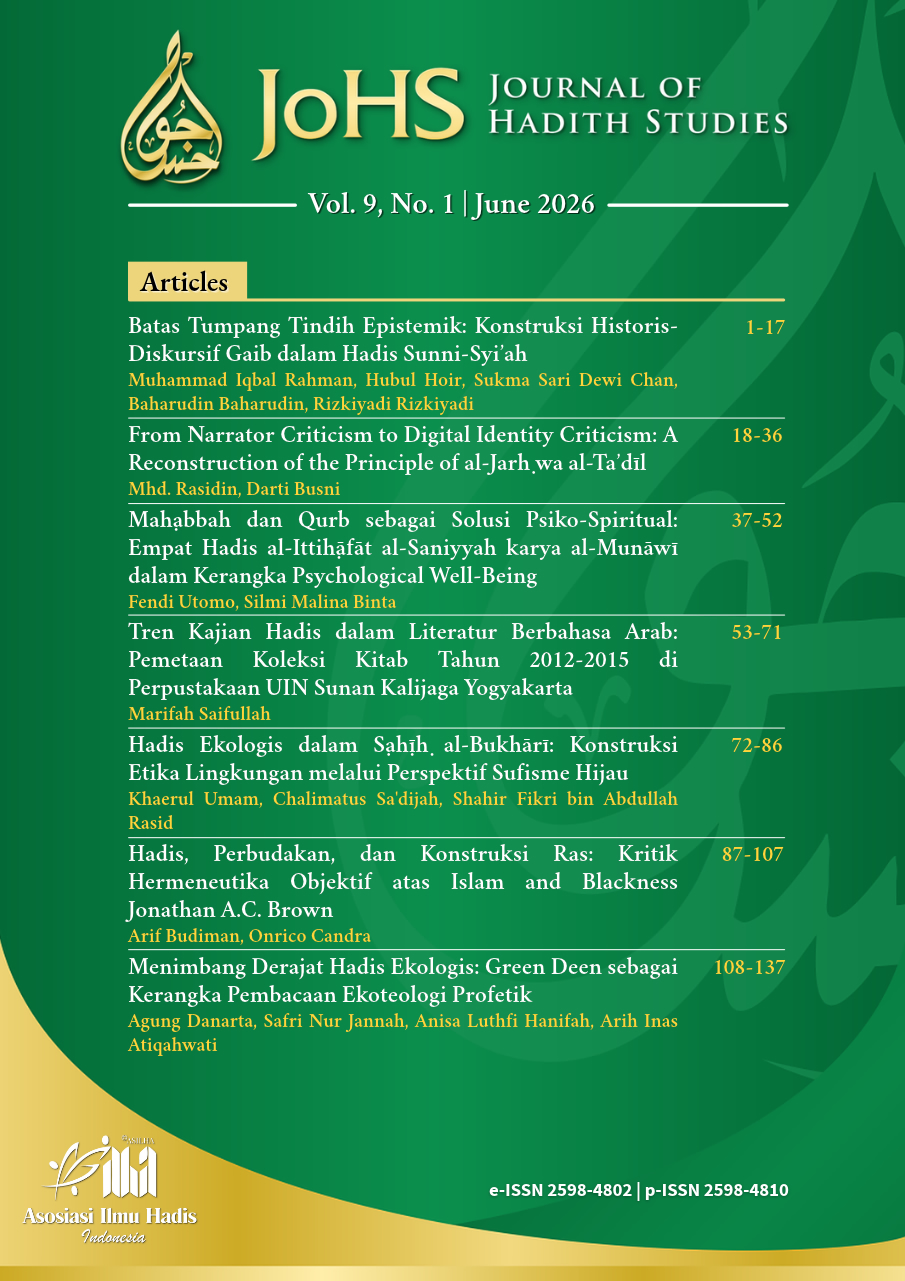
Menimbang Derajat Hadis Ekologis: Green Deen sebagai Kerangka Pembacaan Ekoteologi Profetik
DOI:
https://doi.org/10.32506/johs.v9i1-06Keywords:
prophetic ecology, Islamic environmental ethics, ecological hadith, green deen, ecotheologyAbstract
This study responds to the escalating global environmental crisis and the growing need for Muslims to ground environmental preservation in religious ethics and theology. Prophetic traditions that encourage tree planting, prohibit isrāf (wastefulness), set out the principle of lā ḍarar wa lā ḍirār (neither inflicting harm nor reciprocating harm), and describe cleanliness as part of faith carry ecological values that remain relevant today. Previous scholarship, however, has generally treated ecological ḥadīths normatively or thematically, without weighing the grade of transmission, matn variants, classical shurūḥ, and contemporary ecotheology within one analytical framework. This descriptive qualitative library study examines primary ḥadīth sources and classical commentaries. It assesses the grade of each report through the judgments of ḥadīth critics and takhrīj literature, analyzes matn variants, and maps the content onto the green deen framework. The findings show that grades differ across the four themes: the core reports on tree planting and cleanliness appear in Ṣaḥīḥ al-Bukhārī or Ṣaḥīḥ Muslim, while some reports on isrāf and lā ḍarar wa lā ḍirār are disputed and serve as corroboration. Read together, the four groups articulate an environmental ethic centered on responsibility, balance, and sustainability. Unlike earlier thematic mappings, this study proposes a conceptual reading framework that links the quality of transmission to green deen principles, offering a theoretical contribution to Islamic ecotheology and a basis for environmental da’wah, ecological education, and sustainability-oriented policy.
Downloads
References
Al-‘Asqalānī, Ibn Ḥajar. Fath Al-Bārī Bi Sharḥ Ṣaḥīḥ al-Bukhārī. 10. Beirut: Dār al-Kutub al-‘Ilmiyya, 2000.
Al-Baihaqi, Abu Bakr Ahmad bin Al-Husain bin Ali. Al-Sunan Al-Kabir. 1st ed. Vol. 11, edited by Dr. Abdullah bin Abdul Muhsin At-Turki. Kairo: Markaz Hajar lil-Buhuts wad-Dirasat Al-Arabiyyah wal-Islamiyyah, 2011.
Albānī, Muḥammad Nāṣir ad-Dīn al-. Ṣaḥīḥ Sunan An-Nasā’ī, Bikhtiṣār as-Sanad. 1st ed. Vol. 2. Riyadh: Maktab at-Tarbiyah al-‘Arabī li Duwal al-Khalīj, 1988.
———. Silsilatul Aḥādīṡ Al-Ṣaḥīḥah Wa Syai’un Min Fiqhihā Wa Fawā’idihā. 1st ed. Vol. 7. Riyadh: Al-Ūlā li-Maktabatil Ma’ārif, 2002.
Al-Haddad, Muhammad-Musa. “Islamic Ecology Tradition, Independence, and Global Contribution.” In El Harakah: Jurnal Budaya Islam, 2026th-06–15th eds., 28:26. no. 1. 2026. https://doi.org/10.18860/eh.v28i1.40502.
Al-Imam, Ahmad Abdur Rahman. “The Influence of Modernity on Matn Criticism: A Comparative Study of Traditionist and Reformist Approaches in Ibn Hajar’s Fath al-Bari and Rashid Rida’s Majallat al-Manar on Hadīths of Natural Phenomena.” Journal of Islamic Thought and Civilization 16, no. 1 (2026). https://doi.org/10.32350/jitc.161.01.
Al-Ju’fi, Abu Abdullah, Muhammad bin Isma’il bin Ibrahim bin Al-Mughirah bin Bardizbah Al-Bukhari. Ṣaḥīḥ Al-Bukhārī. 1st ed. Vol. 3, edited by Dr. Muḥammad Zuhair al-Nāṣir. Beirut: Dar Ṭawq al-Najah, 1422.
Al-Kufi, Abu Bakr Abdullah bin Muhammad bin Abi Syaibah Al-’Absi. Al-Mushannaf. 1st ed. Vol. 13, edited by Sa’d bin Nashir bin Abdul Aziz Abu Habib Asy-Syitsri, with Nashir bin Abdul Aziz Abu Habib Asy-Syitsri. Arab Saudi: Dar Kunuz Isybiliya, 2015.
Al-Mubārakfūrī, Al-Mubārakfūrī. Tuhfat Al-Ahwadhī Bi Sharḥ Jāmi‘ al-Usūl. 2. Karachi: Maktabah Ma‘ārif, 1998.
Al-Nawawī, Al-Nawawī. Al-Minhāj Sharḥ Ṣaḥīḥ Muslim. 4. Beirut: Dār al-Kutub al-‘Ilmiyya, 1997.
Al-Qazwīnī, Abū ’Abdillāh Muḥammad ibn Yazīd ibn Mājah. Sunan Ibni Mājah. 1st ed. Vol. 1, edited by Syu’aib al-Arnaūṭ, ‘Ādil Mursyid, Muḥammad Kāmil Qarah Bilī, and ’Abdullāh al-Laṭīf Ḥarzullāh. Beirut: Dār al-Risālatil ’Ālamiyyah, 2009.
Amir, Sulaiman Muhammad, Juli Julaiha P, Hashim Mohammed Adam Hasabalh, and Alwi Padly Harahap. “Environmental Ethics in the Hadith: Building Ecological Awareness in the Era of Global Warming.” Diroyah: Jurnal Studi Ilmu Hadis 9, no. 2 (2025). https://doi.org/10.15575/diroyah.v9i2.39470.
Anas, Mālik bin. Al-Muwaṭṭa’. Vol. 2, edited by Muḥammad Fu’ād ’Abdil Bāqī. Beirut: Dāru Iḥyā’it Turāṡil ’Arabī, 1985.
———. Muwaṭṭa’ al-Imām Mālik. 1st ed. Vol. 1, edited by Dr. Basysyār ’Awwād Ma’rūf and Maḥmūd Muḥammad Khalīl. Beirut: Mu’assasah ar-Risālah, 1991.
An-Nawawī, Abū Zakariyyā Muḥyī ad-Dīn Yaḥyā bin Syaraf. Al-Minhāj Syarḥ Ṣaḥīḥ Muslim Bin al-Ḥajjāj. 2nd ed. Vol. 3. Beirut: Dār Iḥyā’ at-Turāts al-‘Arabī, 1392.
An-Nawawī, Muḥyī ad-Dīn, and Ibn Rajab al-Ḥanbalī. Al-Arba’ūn an-Nawawiyyah (Ma’a Ziyādāt Ibn Rajab Raḥimahumā Allāh). Edited by Asy-Syarbīnī bin Fāyiq Asy-Syarbīnī. With Muṣṭafā bin al-‘Adawī. Maktabah Syamilah, 1440.
Aouati, Fatima Zohra, and Khaled Obaideen. “Sustainable Development Goal 6 and the Prophetic Guidance on Water: A Hadīth-Based Framework.” Journal of Islamic Thought and Civilization 15, no. 2 (2025). https://doi.org/10.32350/jitc.152.08.
Apriantoro, Muhamad Subhi, Indah Noor Rahayuningsih, and Sarwanto Sarwanto. “Implementation of Green Economy Through Integrated Urban Farming as Family Economic Resilience During The Pandemic: Maqasid Sharia Perspective.” IQTISHODUNA: Jurnal Ekonomi Islam 11, no. 1 (2022): 1.
Asmana, Azis, Husen Zenal Mutaqin, Lani Lasna Ulhaq, and Risyan Nurhakim. “Ecological Ṣadaqah and Sustainability: A Comparative Study of Ḥadith Commentaries on Tree Planting in Ikmāl al-Mu’lim and Fatḥ al-Mun’im.” Diroyah: Jurnal Studi Ilmu Hadis 11, no. 1 (2026). https://doi.org/10.15575/diroyah.v11i1.58724.
‘Asqalānī, Abū al-Faḍl Aḥmad bin ‘Alī bin Muḥammad bin Aḥmad bin Ḥajar al-. At-Talkhīṣ al-Ḥabīr Fī Takhrīj Aḥādīts Ar-Rāfi’ī al-Kabīr. 1st ed. Vol. 1, edited by Abū ‘Āṣim Ḥasan bin ‘Abbās bin Quṭb. Mesir: Mu’assasah Qurṭubah, 1995.
‘Asqalānī, Aḥmad bin ‘Alī bin Ḥajar al-. Fatḥ Al-Bārī Syarḥ al-Bukhārī. 1st ed. Edited by Muḥibb ad-Dīn al-Khaṭīb. Vol. 5, edited by Muḥammad Fu’ād ’Abd al-Bāqī. As-Salafiyyah al-Ūlā, 1390.
Asy-Syāṭibī, Abū Isḥāq Ibrāhīm bin Mūsā bin Muḥammad al-Lakhmī. Al-Muwāfaqāt. 1st ed. Vol. 1, edited by Abū ‘Ubaidah Masyhūr bin Ḥasan Āl Salmān, with Bakr bin ‘Abd Allāh Abū Zaid. Dār Ibn ‘Affān, 1997.
Blankinship, Lisa A., Sarah Gillaspie, and Basil H. Aboul-Enein. Highlighting the Importance of Biodiversity Conservation through the Holy Qur’an. June 6, 2024. https://doi.org/10.1111/cobi.14309.
Choironi, M. Alvin Nur, and M. Khoirul Huda. “Greening the Sunnah: Authenticity, Recontextualization, and the Discursive Function of Hadith in the GreenHajj Guide.” An-Nur: International Journal of Quran & Hadith 3, no. 2 (2025). https://doi.org/10.62032/aijq%20h.v3i2.144.
Dāraquṭnī, Abū al-Ḥasan ‘Alī bin ‘Umar bin Aḥmad bin Mahdī bin Mas’ūd bin an-Nu’mān bin Dīnār al-Baghdādī ad-. Sunan Ad-Dāraquṭnī. 1st ed. Vol. 4, edited by Syu’aib al-Arna’ūṭ, Ḥasan ‘Abd al-Mun’im Syalabī, ’Abd al-Laṭīf Ḥirz Allāh, and Aḥmad Barhūm. Beirut: Mu’assasah ar-Risālah, 2004.
Erich Chandra, Mugiyono, and Sulaiman M. Nur. “EKOTEOLOGI DALAM PERSPEKTIF HADIS: KAJIAN MA’ANILHADIS ANJURAN MENANAM BENIH MENJELANG KIAMAT.” Jurnal Diskursus Islam 14, no. 2 (2026). https://doi.org/10.24252/jdi.v14i2.70993.
fī, Abū ’Abdillāh Muḥammad ibn Ismā’īl al-Bukhārī al-Ju’. Ṣaḥīḥ Al-Bukhārī. 5th ed. Vol. 5, edited by Dr. Muṣṭafā Dīb Al-Bughā. Damaskus: Dār Ibni Kaṡīr, Dārul Yamāmah, 1993.
Foltz, Richard, Fred Denny, and Ainin Baharuddin. Islam and Ecology: A Bestowed Trust. Harvard University Press, 2003.
Gade, Anna M. “Three. A Qur’anic Environment: Relating Creatures and Resources.” In Muslim Environmentalisms, 78–117. Columbia University Press, 2019. https://doi.org/10.7312/gade19104-004.
Ḥanbal, al-Imām Aḥmad bin. Musnad Al-Imām Aḥmad Bin Ḥanbal. 1st ed. Vol. 11, edited by Syu‘aib al-Arnā’ūṭ and ‘Ādil Mursyid. Beirut: Mu’assasah al-Risālah, 2001.
Ḥanbalī, ‘Alā’ ad-Dīn Abū al-Ḥasan ‘Alī bin Sulaimān al-Mardāwī ad-Dimasyqī aṣ-Ṣāliḥī al-. At-Taḥbīr Syarḥ at-Taḥrīr Fī Uṣūl al-Fiqh. 1st ed. Edited by Dr. ‘Abd ar-Raḥmān al-Jibrīn, Dr. ‘Awaḍ al-Qarnī, and Dr. Aḥmad al-Sarrāḥ. Arab Saudi - Riyadh: Maktabah ar-Rusyd, 2000.
Hidayat, Eka Rahmat, Hasim Danuri, and Yanuar Purwanto. “ECO MASJID: THE FIRST MILESTONE OF SUSTAINABLE MOSQUE IN INDONESIA.” Journal of Islamic Architecture 5, no. 1 (2018).
Hidayat, Muhammad Syahrul, and Ahmad Munir Hamid. “Green Economy Development through Urban Farming: A Maqāṣid Sharī’ah Review.” ADILLA: Jurnal Ilmiah Ekonomi Syari’ah 7, no. 2 (2024): 98–115.
ī, Abū ’Abdirraḥmān Aḥmad bin Syu’aib al-Nasā’. Sunan Al-Nasā’ī al-Mujtabā. 1st ed. Vol. 5, edited by Muḥammad Riḍwān ’Araqsūsī, Muḥammad Mu’tazzuddīn, and ’Ammār Rīḥāwī. Beirut: Dār al-Risālatil ’Ālamiyyah, 2018.
Ibnu Rajab, Zainuddin Abul Faraj Abdur Rahman bin Syihabuddin Al-Baghdadi Ad-Dimasyqi. Jami’ Al-’Ulum Wal-Hikam Fi Syarhi Khamsin Hadits Min Jawami’ Al-Kalim. 7th ed. Vol. 2, edited by Syu’aib Al-Arna’uth and Ibrahim Bajis. Beirut: Muassasah Ar-Risalah, 1997.
Ibnu Rajab, Zainuddin Abul Faraj Abdurrahman bin Syihabuddin. Jami’ Al-’Ulum Wal Hikam Fi Syarh Khamsina Haditsan Min Jawami’ Al-Kalim. 1st ed. Edited by Dr. Mahir Yasin Al-Fahl. Beirut: Dar Ibnu Katsir, 2008.
Karim, Abdul. “Dakwah Melalui Media: Sebuah Tantangan Dan Peluang.” At-Tabsyir 4, no. 1 (2016).
Khalid, Fazlun. “Islam and the Environment – Ethics and Practice an Assessment.” Religion Compass 4, no. 11 (November 2010): 707–16. https://doi.org/10.1111/j.1749-8171.2010.00249.x.
Khalid, Fazlun M. “Islam and the Environment.” Encyclopedia of Global Environmental Change 5, no. 1 (2002): 332–39.
Khasani, Fahim. “Ecological Ethics of the Prophet: A Hadith-Based Framework for Islamic Environmental Thought.” Journal of Modern Islamic Studies and Civilization 3, no. 3 (2025): 310–23.
Matin, Ibrahim Abdul. Green deen: What Islam Teaches About Protecting the Planet. Berrett-Koehler Publishers, 2010.
Mubārakfūrī, Abū al-‘Alā’ Muḥammad ‘Abd ar-Raḥmān bin ‘Abd ar-Raḥīm al-. Tuḥfah Al-Aḥważī Bi Syarḥ Jāmi’ at-Tirmiżī. Vol. 1. Beirut: Dār al-Kutub al-‘Ilmiyyah, n.d.
Murād, Dr. Faḍl bin ‘Abd Allāh. Al-Muqaddimah Fī Fiqh al-‘Aṣr. 2nd ed. Vol. 1. Ṣan’ā’: Al-Jīl al-Jadīd Nāsyirūn, 2016.
Mutma’inah, Mutma’inah, Ahmad Azis Abidin, Fadiah Qothrun Nada, and Thiyas Tono Taufiq. “GREEN-DEEN IN THE QUR’AN: A STUDY OF TAFSIR AL-IBRīZ THE WORK OF BISRI MUSTHOFA.” Aqlam: Journal of Islam and Plurality 9, no. 1 (2024). https://journal.iain-manado.ac.id/index.php/AJIP/article/view/2803.
Naisābūrī, Abū ‘Abd Allāh Muḥammad bin ‘Abd Allāh al-Ḥākim al-. Al-Mustadrak ’ala al-Ṣaḥīḥain. 1st ed. Vol. 2, edited by Muṣṭafā ‘Abd al-Qādir ‘Aṭā. Beirut: Dār al-Kutub al-‘Ilmiyyah, 1990.
Naisābūrī, Abu al-Ḥusain Muslim bin al-Ḥajjāj al-Qusyairī al-. Ṣaḥīḥ Muslim. Vol. 1, edited by Muḥammad Fu’ād ’Abdil Bāqī. Kairo: Maṭba’ah ’Īsā al-Bābī al-Ḥalabī wa Syurakāh, 1955.
Nasr, Seyyed Hossein. Man and Nature. 1st ed. London: Unwin Paperbacks, 1990.
Nawawī, Abū Zakariyyā Muḥyī ad-Dīn Yaḥyā bin Syaraf an-. Al-Arba’ūn an-Nawawiyyah. 1st ed. Beirut: Dār al-Minhāj lin-Nasyr wat-Tauzī’, 2009.
Noriko, Nita, Andi Mukramin Yusuf, and Elma Alfiah. Gerakan Masyarakat Sedekah Air Wudhu (GM-SAW) Sebagai Upaya Konservasi Air Bersih. 2022. https://eprints.uai.ac.id/1833/.
Özdemir, İbrahim. “THE EVOLUTION AND FUTURE OF RELIGION AND ECOLOGY: INSIGHTS FROM MUSLIM ENVIRONMENTAL THOUGHT.” The New Ecozoic Reader, 2025, 52.
Qārī, ’Alī bin (Sulṭān) Muḥammad al-, Abū al-Ḥasan Nūr ad-Dīn al-Mullā al-Harawī. Mirqāt Al-Mafātīḥ Syarḥ Misykāt al-Maṣābīḥ. 1st ed. Vol. 1. Beirut: Dār al-Fikr, 2002.
Radkau, Joachim. “Religion and Environmentalism.” In A Companion to Global Environmental History, 463–78. John Wiley & Sons, Ltd, 2025. https://doi.org/10.1002/9781119988229.ch30.
Robinson, Deena. “15 Biggest Environmental Problems of 2025.” Earth.Org, January 9, 2025. https://earth.org/the-biggest-environmental-problems-of-our-lifetime/.
Sabir, Ghezal, Lina M. Tennhardt, and Robert Home. “Heaven and Earth: A Systematic Review of Theories on the Relationship between Religion and Environmental Behaviour.” Discover Sustainability 6, no. 1 (March 2025): 178. https://doi.org/10.1007/s43621-025-01005-2.
Santono, Agung Nugroho Reformis, Muhammad Zainuddin, Muhammad Lytto Syahrum Arminsa, Muhammad Ikhya Ulumuddin, Tholhah, Nasirin, Aidul Fitriawan, Dannu Akbar, and Nurul Jannah. “Re-Sacralization of Nature and Sufi Ecotheology: Seyyed Hossein Nasr’s Contribution to Environmental Ethics in the Anthropocene.” Journal of Islamic Thought and Civilization 16, no. 1 (2026). https://doi.org/10.32350/jitc.161.22.
Sijistānī, Abū Dāwud Sulaimān bin al-Asy’aṡ al-Azdī al-. Sunan Abī Dāwud. 1st ed. Vol. 1, edited by Syu’aib al-Arnaūṭ and Muḥammad Kāmil Qarah Bilī. Beirut: Dar al-Risalah al-’Alamiyyah, 2009.
Solichin, Moh. Badrus, and Moh. David Bahtiar. “Deconstructing The Concept of ‘Green deen’ By Abdul Martin and Its Implementation for Boarding Schools in The City of Kediri.” Proceeding International Conference on Education 1 (2023). https://jurnalfaktarbiyah.iainkediri.ac.id/index.php/proceedings/article/view/1785.
Stefanus, Tonny Andrian, and David Ming. “Beyond Anthropocentrism: A Comparative Ecotheological Framework of Khalīfah Fīl-Arḍ and Imago Dei toward Theo-Ecocentrism.” Jurnal Theologia 37, no. 1 (2026). https://doi.org/10.21580/teo.2026.37.1.308320.
Taṣduru ‘an Munaẓẓamah al-Mu’tamar al-Islāmī bi Jiddah. Majallah Majma’ al-Fiqh al-Islāmī at-Tābi’ Li Munaẓẓamah al-Mu’tamar al-Islāmī Bi Jiddah. n.d.
Ṭayyār, Prof. Dr. ‘Abd Allāh bin Muḥammad aṭ-, Prof. Dr. ‘Abd Allāh bin Muḥammad al-Muṭlaq, and Dr. Muḥammad bin Ibrāhīm al-Mūsā. Al-Fiqh al-Muyassar. 1st ed. Vol. 13. Arab Saudi - Riyadh: Madār al-Waṭan lin-Nasyr, 2011.
Tirmiżī, Abū ’Īsā Muḥammad bin ’Īsā bin Saurah al-. Al-Jāmi‘ al-Kabīr (Sunan al-Tirmiżī). 1st ed. Vol. 5, edited by Syu‘aib al-Arnā’ūṭ. Beirut: Dār ar-Risālah al-‘Ālamiyyah, 2009.
Ulya, Naily Himmatul. “Konsep Greendeen Dalam Perspektif Al-Qur’an (Kajian Ayat-Ayat Pelestarian Lingkungan Dalam Tafsir Kementerian Agama RI).” PhD Thesis, UIN KH Abdurrahman Wahid Pekalongan, 2024. http://etheses.uingusdur.ac.id/id/eprint/9344.
York, Michael. “Religion and the Environmental Crisis.” In Ecotheology - Sustainability and Religions of the World. IntechOpen, 2022. https://doi.org/10.5772/intechopen.104002.
Zulfarizal, Zulfarizal, Laila Sari Masyhur, Zakiyah Zakiyah, and Alven Putra. “Prophetic Ecotheology and the Indonesian Ecological Crisis: A Hadith-Based Approach.” Jurnal Ushuluddin 34, no. 1 (2026). https://doi.org/10.24014/jush.v34i1.38886.
Downloads
Published
Issue
Section
License
Copyright (c) 2026 Agung Danarta, Safri Nur Jannah, Anisa Luthfi Hanifah, Arih Inas Atiqahwati (Author)

This work is licensed under a Creative Commons Attribution-NonCommercial-ShareAlike 4.0 International License.